A Spider Hangs on a Thread of the Ancient Goddess Myth

Tags

, , , , , ,

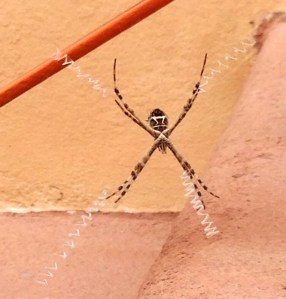
Weaving her web on my patio today

She was hanging in space – in a web of her own creation. I was intrigued by the zigzag pattern that she created. Most people take one look and think “Creepy!”  But I always think of Arachne (or Ariadne), one of the great goddesses of Ancient Crete. I have a hard time just going for the broom immediately so I let her hang around a bit before I almost fell into her web, then sent her running to another part of the garden.

There are a number of myths about Arachne, the Weaver Goddess. She was mistress of the Labyrinth in Minoan Crete  who led Theseus to the center and safely out again with her golden thread. But before gaining goddess status, as a mere mortal she refused to give Athena, goddess of wisdom and craft, credit for her weaving expertise and challenged her to a weaving contest. Athena became enraged at her more beautiful cloth and it’s depiction of Zeus and his amorous conquests and turned Arachne into a spider.

As an archetype, she helps us find our soul at the center of ourselves, via the Labyrinth. In biology, spiders are classified as “arachnids” after the Greek Goddess. So although a little creepy to allow her free reign, I find it more unsettling to squash this symbol of the ancient goddess.


The Sacred Rock – Uluru (Ayer’s Rock), Australia

Tags

, , , , , , ,

Uluru Ayers Rock, Australia

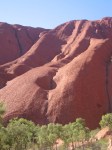
On my second trip to Australia in 2008, I made a pilgrimage to Uluru in the Northern Territory, (better known as Ayer’s Rock, named after the European who ‘discovered’ it). Ofcourse this land has been held sacred by the Anangu, the Aboriginal people for thousands of years. This huge red rock rising out of the desert has a mythical, mysterious quality.

After settling into my hotel,  I took a shuttle bus to view Uluru at sunset – the perfect photo op. The next morning, I set out  with the intent to have a more intimate experience with the sacred rock. The Aborigines request that visitors not climb it yet the Australian Parks Department who leases the site from the Aboriginal people, allow it. I was in the minority who chose to respect the sacredness of the site and walk around the base of the rock, a distance of 10.6 km.

(click on images below to enlarge)

As I walked, I did a meditation and communed with mother nature, and the spirit of the ancestors. Around every corner were undulating rocks, sensuous and feminine, in colors that ranged from rose to bright red to purple. I was delighted to find several small caves along the periphery with drawings of spirals and other creation myth symbols. (My heading on this blog is from one of the caves.) What a gift to have the opportunity to walk this sacred land, following in the footsteps of the ancestral beings and feeling the connection to Spirit!

The Heritage Trust is an organization whose goal is to protect ancient sites and artefacts around the world. They just mentioned in their latest blog the plight of many rock art sites in Australia that aren’t being protected, Erasing Australia: A Journey to Destruction. Read more here….

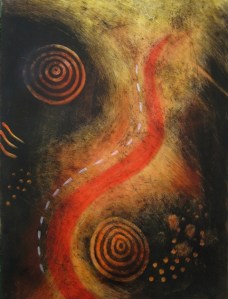
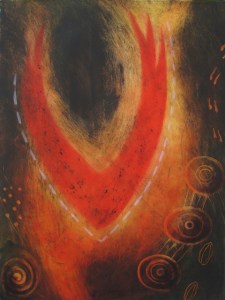
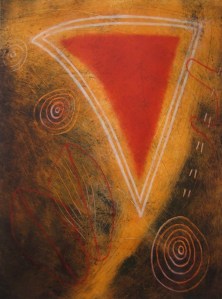
This is a few prints from a series of monotypes, Notes from Uluru, 30″ x 22″, I created upon returning to my studio. They reflect the vivid colors of the earth and the symbols hidden away in the caves -my own vision and experience.

(click on images below to enlarge)

‘Notes from Monte Alban’ – Inspiration from Mexico’s Zapotec Pyramid

Tags

, , , , ,

Monte Alban, Zapotec pyramid, Oaxaca, Mexico

Although I was originally drawn to neolithic sacred places in Old Europe for their feminine energy, I now find myself living in Mexico – a rich landscape of pyramids and archeological sites. The ancient cultures, including the Zapotecas, Aztecs, Mixtas and Mayans, seemed to have been male-dominated societies, yet Madre Tierra (Mother Earth) was also revered in various forms such as Coatlicue, as well as the four elements in nature: Earth, Wind, Fire and Water. Visiting these sites, I focus on the glyphs carved and painted on the pyramid walls wondering how they will find their way into my work. I find a place away from the crowd to commune with the spirits, do a silent meditation or yoga.

Glyps from Monte Alban:

stone glyphs sm

Outside of Oaxaca lies Monte Albán, an ancient Zapotec site with an impressive complex of pyramids and an expansive view of the countryside. Here I felt a sense of spirit, a sense of place. I was entranced by the multitude of stone monuments inscribed with figures and symbols, a hidden language whose forms intrigued me.  Back in the studio, I found myself mixing and matching the vertical stacks of glyphs, circles, dots and wavy lines, and then pairing them with more feminine symbols such as the vesica piscis and the spiral. Perhaps it was my little cosmic joke to balance the yin to the yang, and thus provide a completeness and wholeness to these ancient images.

Glyphs from Monte Alban resulted in a series of Monotype prints, one of a kind images created by painting with ink on acrylic plate, then running it through an etching press to transfer it to paper. Many layers of ink, rolled on with a brayer, brush or fingers build up a rich surface.  The prints in the gallery below are all 30″ x 22″

I offer a Oaxaca Art Vacation to artists (advanced to beginners) where we visit the pyramids, local artesans, do a hand-made paper workshop in Etla, and a 5 day monotype printmaking workshop. Visit my website for more information: www.glenrogersart.com

Introduction to the Artist and Her Blog

Tags

, , , ,

Glen in studio sm

The motivation for this blog is to share my journey to sacred sites around the world.  I write from the perspective of an artist – not as a scientist or an archeologist.  I take pilgrimages to these incredible sites as a way to connect with spirit of place, to walk in the footsteps of the ancestors, to see the symbols carved in stone and painted on cave walls first-hand.  I stand in awe and bask in the mystery of what once was and what is left behind.

As a visual artist, I take my inspiration from these journeys. I’m a painter, printmaker, sculptor – an expat living in Mazatlan, Mexico.  Originally from Mississippi, I lived in the San Francisco Bay Area before moving to Mexico. I’ve always got lots of work going on in the studio, currently I am working on paintings inspired by the ‘vesica piscis’, a form in sacred geometry that is prominent in my work. It is a feminine shape formed by 2 interlocking circles – the womb, the divine mother. (watch for a future blog on this symbol)  Also in the works is a bronze sculpture for the City of Mazatlan, ‘Aleteo’, with imagery of flora and fauna from the area. (More about this soon!) My prints are currently inspired by the Nazca Lines in Peru (see one of my earlier posts.)

In addition to my own artwork, I also teach printmaking workshops to locals and international artists in my studio in Mazatlan as well as take artists on ‘Art Vacations’ to other great cities like Oaxaca and Guanajuato.  I’m planning the next one for Peru and should be great!

Art and Sacred Sites: Connecting with Spirit of Place, a book of my journeys and artwork

Art and Sacred Sites: Connecting with Spirit of Place, book of my journeys and artwork

In May 2014, I published a book, Art and Sacred Sites: Connecting with Spirit of Place, about my journeys and inspirations. (Available through my website: www.glenrogersart.com) I was motivated to produce the book when I realized there was a pattern to my travels over the last twenty years – I would visit a sacred site, then return to the studio to create a body of work. I have sought out sites around the world that held meaning and fascination for me from the Temple of Knossos in Crete to Uluru in Australia.

Although I have kept a journal for many years, writing the text for the book was a challenge – but one I came to enjoy. Now that it is in print, I realize I enjoyed the writing and feel the need to continue to share my experiences through this blog. I would love to connect with other artists, adventurers or armchair travelers who share my fascination with the ancients – with those who have come before us.

Aboriginal Rock Art and Sacred Inspiration

Tags

, , , , , , , , , , , , , , , , , ,

The Rainbow Serpent

On my first trip to Australia, I visited Cooktown north of Cairns on the Cape York Peninsula.  I specifically sought out rock art since I knew the indigenous culture dated back thousand of years. I had scoped out an area about 25 miles out that was protected by park lands, but then noticed a message on a bulletin board advertising a walk thru the bush with an aboriginal guide. I jumped at the opportunity to visit the ancestral lands of the Nugal-wara normally closed to the public. There were 5 or 6 of us who signed up to walk into the bush with Willie Gordon, an Aboriginal guide and tribal elder. He led us through a landscape of towering sandstone rock formations that we experienced from above, and then into the gorges.

Wille Gordon, Aboriginal guide and tribal elder

The rock art was in small overhangs that formed a series of caves. We saw the “cave of reconciliation”, where clan would meet to resolve issues with outcasts from the tribe. Then we entered the birthing cave, with drawings of a pregnant woman, a child, and an upside-down image of a man (because men weren’t allowed inside the cave.)

The Birthing Cave

In another cave, images of a rainbow serpent, their image of Mother Earth, were drawn on the wall with pigments  from the earth. When we stopped, Willie would draw images in the sand, sharing tribal myths and symbols, but what most touched me was his sharing from the heart. He explained, ‘It is our spirituality that determines our survival.” He spoke of the ‘light’, the Aboriginal basis for their connection to Spirit, and explained how the rainbow serpent is their connection to Earth, the practical. Water and light are their two most important spiritual elements, and he described how the cave paintings represent a pathway through life. Even today, the tradition of painting on the walls continues, as each generation adds their own marks leaving a legacy for the next. This was such a blessed opportunity to spend time with Willie Gordon as he shared with us his ancestral history and spiritual connections.

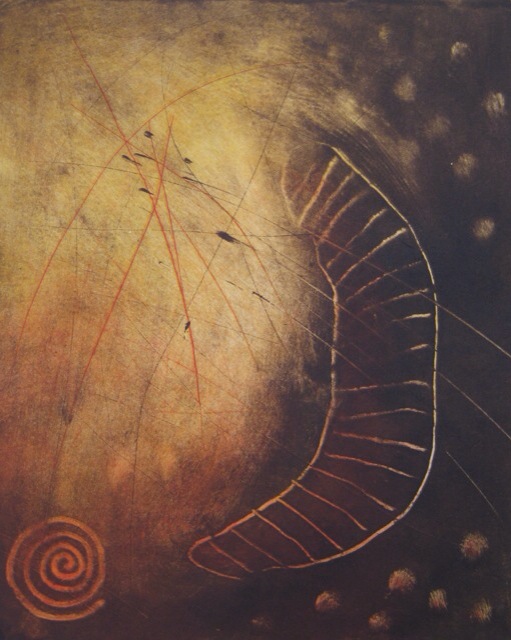
Back in the studio, I was moved to capture the essence of these cave paintings, so I began a suite of small monoprints called “Writing on the Wall.” Layering the images from my mind’s eye and from photos I’d taken, my intention was to create a rich surface that sparkled with the mystery I’d felt on this sacred land. I interwove images of the Rainbow Serpent with nature imagery such as spirals and textures carved into the caves. Scratching into the plate using the drypoint process, I created a rich surface before applying the ink to the plate. Subtle layers of transparent color were rolled on or added by hand (a la poupee) after the initial dark umber matrix. Each print is unique, a one of a kind image. Some of the prints are still available, contact me to view more images.

‘Writing on the Wall’ series of monoprints


10 Ways Travel Makes My Heart Sing

Tags

, , , , , , ,

Glen at Uluru

Uluru (Ayer’s Rock), Australia, 2008

I love to travel! As an artist, it is where I find my inspiration. I feel alive and fully awake outside my comfort zone. I love the new experiences and meeting new people.  And I’ve figured out ways to travel well without breaking the bank. I use my frequent flyer miles to fly to amazing places (that’s getting me to Italy in September).  I’ve been doing house exchanges for many years now – and have several coming up (San Miguel de Allende and South of France) – which translates to staying in wonderful homes in amazing places for free!  I’ve done many artist residencies most of which were also free of charge – Frans Masereel Centrum, Belgium;Helene Wurlitzer,Taos, New Mexico; Fundacion Valparaiso, Spain to name a few.  And I have done artist exchanges, where we exchange homes and studios. I’ve been lucky – but as they say, “Luck follows the prepared mind.” I plan ahead, do my research and put it out to the Universe.

“A pilgrimage is any journey with the purpose of finding something that matters deeply to the traveler.” Phil Cousineau

I don’t take travel lightly. I choose a place that I resonate with – where I’m drawn to – whether it’s a pilgrimage to an ancient sacred site or a city that inspires with art and culture, or a artist residency or exchange that is sure to feed my spirit.  I’ve come up with 10 reasons how travel makes my heart sing.

  1. Awakening my creative spirit. I grab a pencil, a brush, my camera to freeze the moment and capture the essence. New inspiration comes in the form of a symbol inscribed in stone, a fresco, an ancient sculpture. My trip sparks a new interest – a new shape, a new color, a new form. I discover an artist’s work, learn a new technique, see a new color combination. I jot down notes, make sketches, save scraps of paper that I can later use as collage. I can’t wait to get back to the studio to explore these new ideas.
  2. Meeting new people – expanding my world – from the taxi driver to the food vendor, to the hotel personnel – I try to engage. I ask a local for advice on where to eat, where to listen to music, what’s their favorite hang-out – and often that develops into a rich sharing.  I try to seek out artists in their studios, on the street, or in the galleries. As a printmaker, I love visiting print studios – often inviting the artist to visit me in Mazatlan, and perhaps we stir up an exchange, an exhibition, a workshop – furthering the connection.
  3. Taking a pilgrimage to a sacred site – I approach with anticipation and reverence honoring those who came before me. I am fully engaged and try to activate my 6th sense and imagination; who walked these very cobblestones, who carved these symbols with their hands? I rarely hire a guide because I want to walk the site as close to alone as possible, to feel the spirit of place. I look for a special spot where I can commune with the ancestors, the gods and goddesses. If possible, I do a short meditation, yoga, or tai chi. “The person who travels to a sacred site is not the same person when they return home. They have awakened to a greater respect for the planet, accelerating a beautiful unity and harmony between all living people, cultures, and religions. The ancient one who created these sites help us remember that this is the most important truth there is. ” Aluna Joy Yaxkin
  4. Learning the history of a people who walked the earth before me. I prefer to ‘google’ a site before and after visiting vs hiring a guide. There is so much information available on the internet – and honestly – I won’t remember the details and dates anyway. I take away what I am interested in –  What was their life like? What were their rituals? Who did they worship? What were their symbols? Were they peace loving or warriors?  Were they connected to the earth and the heavens? What did they leave behind?
  5. Opening myself to adventure and the unknown – I love my life, but sometimes I just need to shake it up! I think I’ve always been this way. I don’t think its running away – its running towards something I can’t quite put my finger on, to something I can’t plan or even imagine. Beyond my wildest dreams! Opening myself to new experiences that will somehow change me, and perhaps have a spiritual impact. In Phil Cousineau’s book, The Art of Pilgrimage, he recounts a story about Joseph Campbell who said, “Unless you leave room for serendipity, how can the divine enter in? The beginning of the adventure of finding yourself is to lose your way.”
  6. Experiencing new cultures – From eating delicacies of a region to enjoying local music, I travel outside the tourist areas if necessary and seek out the local delights. In Oaxaca, the mole and the hot chocolate, in Peru, the potatoes, quinoa, river trout and pisco sours, in Mazatlan – the fresh fish, shrimp dishes and Pacifico beer.  Music captures the flavor of an area and I seek it out in local cafes, bars, or on the plazas. I delight in the rhythm and move my feet and hips to the music. Visiting the mercados and small shops, the local crafts are a feast for the eyes – from the textiles in Oaxaca and Peru that overwhelm me with their intricate designs, to beautifully painted ceramics in Guanajuato and San Miguel, the wooden and ceramic masks in Patzcauro, and hand-made silver and beaded jewelry most everywhere I travel.
  7. Knowing I can rise to the challenge.  You know what they say – Shit happens! No matter how well planned, or researched, there is always a glitch whether large or small that I have to deal with along the way. It’s problem solving 101, it’s thinking on my feet. In situations like this, I feel my heart quicken and my brain churn as the possible scenarios and solutions play themselves out in my head.  I take a moment to breathe, ask my spirit guides for help, open myself to divine intervention. I say my mantra, “In Her Hands”, calling forth the Goddess energy.  Here are some examples:  I realize the tour company never sent me the entrance ticket to Machu Picchu and I only have the receipt; I discover I am in the wrong terminal 10 minutes before my flight; my taxi driver drops me off in a strange city in Greece after dark with no hotel. Adrenaline pulses through my body.  “For what gives value to travel is fear. It breaks down a kind of inner structure we have.” Camus
  8. Moving out of my comfort zone. My normal routine is replaced by the new and unexpected – new food, new bed, new people, new forms of transportation, new sites and sounds, new time zone, waking at a different hour. My senses are heightened, I am more alert. Although there may be times that something doesn’t live up to my expectations, I always enjoy the differences from my everyday life and it usually makes for a good story! I’m never afraid to change a hotel or even a city if it is not working. (Exit stage left!) I love coming home after a trip to enjoy the contrast between what I just experienced and my normal routine. Maybe something in me has shifted….
  9. Awakening my sense of gratitude. This is true especially if I am traveling in a third world country or seeing people suffering from poverty. I realize how good my life is and how many daily comforts I take for granted. I count my blessings and say a gratitude prayer. I donate to a local charity, purchase hand-made wares directly from the maker if possible, treat everyone with respect, smile and send out love.
  10. Savoring the memories.  Almost as delicious as anticipating a trip, is savoring it once you return home. I share it with my friends over a meal or a cup of coffee.  I exchange experiences, trade stories, especially those: “You won’t believe what happened….”  I enjoy posting photos on Facebook and blogging about my inspirations.  I proudly display my new pot or textile which brings a smile and a memory every time I pass it. The world gets smaller….

Planning a journey is half the fun, right? I’m looking forward to a 3 week artist residency at the Venice Printmaking Studio in Italy followed by a visit with an artist friend in Zurich this September/October and a house exchange in San Miguel de Allende in January. I am also planning two Art Vacations where I take artists to incredible locations to create, make prints and enjoy the sites – 1) Peru – May 2016 and 2)Oaxaca, Mexico – June 2016. Find out more details on my website: http://www.glenrogersart.com or email at glen@glenrogersart.com.

Do you have anything to contribute? I would love to hear your comments.

Meeting the Shaman, Sacred Valley, Peru

Tags

, , , , , , , , , ,

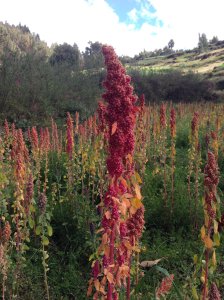
quinoa growing

As I was planning my trip to Peru in May, I saw this as a spiritual journey and dreamed of having an encounter with a shaman,  an intermediary between the natural and supernatural worlds. I even considered taking ayahuasca, a hallucinogenic plant, commonly used by the native people.  But trying to book something like that online was daunting to say the least. I needed to meet the person and have a mutual trust before committing. So I left it to the universe to help me find the right person when I was in the area.  

Once in Peru, I kept my eyes, heart and intuition open to the possibilities. One day while visiting Pisac, a village in the Sacred Valley known for its textile market, I asked a local for recommendations on a lunch place, and he directed us to a small cafe, Apu Organic.  Right away, I could see the owner was into the spiritual and perhaps they could put my friend and I in touch with a shaman.  Maria Elena agreed to connect us with ‘El Viejo’ (the old man), which she referred to as a paco, not a shaman.

On the appointed day, Isaiahs, our translator and guide met us at the Apu Cafe and took us up to the mountain to meet ‘El Viejo’. It was a beautiful walk through fields of quinoa, wheat, maiz, and assorted vegetables – all laid out in free-form plots. As we walked, Isaiahs pointed out herbs used for medicinal purposes and textile dyes. This alone was an extraordinary experience.
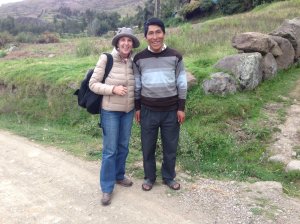
Glen with Isaiahs, our guide and translator

Glen with Isaiahs, our guide and translator

Having reached a simple adobe structure at the top of a hill, we learned this was the home of Don Jesus or ‘El Viejo’. Upon meeting us, he took each of us by both hands, looked deeply into our eyes, which felt like he was looking into our souls.  As he sat on a blanket on the dirt floor, he started by pouring coca leaves into a cloth, having me lay my hands over them while concentrating on my questions. He then read the coca leaves as they dropped from his hand, answering our questions about the future in his native Quechuan language while Isaiahs translated to us in Spanish. After we were satisfied, he proceeded to make a large bundle of various herbs, minerals, shells, milagros, seeds, metal, etc. that he had brought with him in small packets of newspaper. After deliberately placing each item on a square of paper, he folded it up, and began chanting over this offering to Pachamama, Mother Earth. He then had Isaiahs walk us further up the mountain to burn the offering. Reaching a well-used fire pit, Isaiahs showed us how to blow the clouds away since it was threatening to rain. We brought Port Wine, as directed, as an offering to Pachamama as part of our ritual and despite the sprinkles, we felt our offering was successfully received.  This was one of my most treasured moments in Peru, and I left the mountain feeling positive, encouraged, revived and hopeful about the future.

at Apu Organic

At the Apu Organic Cafe in Pisac with Maria Elena (center)
News about Easter Island that blew my mind!

Trolling on Facebook recently, I have come across some amazing new archeological discoveries – this one about the colossal stone heads on Easter Island.  There are 887 of these figurative sculptures carved from rock, known as moai, and found around the island. But only recently have they begun excavating their bodies. And who knew??
Read more at:  http://www.snopes.com/photos/arts/easterisland.asp#mP2UR5XiK0sviyLl.99

http://wisance.com/scientists-uncover-a-shocking-discovery-underneath-the-easter-island-heads-unbelievable/

Easter Island sculptures have bodies!

Walking in the Footsteps of the Ancestors – Caves in South of France

Tags

, , , ,

Lascaux I smLascaux II sm

‘Notes from Font de Gaume’, Monotype Prints by Glen Rogers, 7″ x 5″, 1995

Like so many, I was entranced by the cave drawings from Lascaux, France – exquisite renderings that seem to come alive on the walls of this ancient cave dating back tens of thousands of years. The pigments – red, sienna, ochre, black and white – made from fresh earth, were still vivid and alive, and the exaggerated graphic quality and simplicity of line rivaled the drawing skills of any modern-day master.

Although Lascaux was no longer open to the public, I knew that artists were sometimes given permission to enter and I requested such. When I received no answer, I began researching the Valley of the Caves in the Dordogne region of France. Rather than visit the replica of Lascaux, I wanted to feel the magic of place and actually walk in the footsteps of our ancient ancestors.

So instead, I visited Font-de-Gaume, a small cave outside the town of Les Eyzies. We followed the guide through this dark winding cavern as he used his flashlight to illuminate the drawings.

Lascaux Vsm

‘Lascaux VI’, Monotype Print by Glen Rogers, 7″ x 5″, 1995

Caves were held sacred by the tribes and were used by shamans on their visionary journeys, as places of magic and ritual deep within the womb of Mother Earth.  I was thrilled to see, first-hand, the images of the sacred feminine, vulva shapes in the form of simple triangles, or more organic renditions scratched into the walls. Caves are symbols of birth and death, the passages between worlds. Walking this space was a deeply moving experience that I cherish to this day.

Since it was impossible to get photographs of the cave imagery, I carried these images in my memory. Back in the studio, I created a series of small 5″ x 6″ monoprints with textural lines scratched into the copper plate.  These intimate works, created with colors of the earth, seemed to hold secrets from an ancient time and evoked the magic I’d felt in the caves. This was years ago – 1995 – one of the first pilgrimages I took with the intention of visiting ancient goddess sites. This experience and these prints still hold meaning for me today.

Spirit Gate, a ceremonial gateway

Spirit Gate today photographed by Dan Gross

 A friend just sent me a photo of this sculpture in San Jose, California, wondering if it was one of my public art pieces. Yes, one of my favorites! Spirit Gate located on The Alameda was designed as a ceremonial gateway for Hester School and installed in 2000. It was a collaboration between myself, Bill Gould, and the students and teachers, and supported by a Public Art in Communities Grant.  

As in my 2D art, we focused on  archetypal symbols inspired by the ancients – the circle and the vesica piscis.  We worked with the students to choose ‘power words’  that are cut into the eight foot steel gate. The words – spirit, vision, wisdom, dream, honor and inspire – form the inner core while family, school, friendship and community enclose the center. The two stucco columns are embedded with broken tile mosaics created by the students that illustrate local history. 

I like the way it looks like an ancient relic situated in the modern world with a design that transcends time.

Spirit Gate in 2000 with its shadow image
Glen and Bill working with Hester students
Students & teacher creating mosaics for the columns